A fractional inch, a decimal inch, and a millimeter value can describe exactly the same length. This chart lets you look up that relationship from 0 through 1 in in 1/64 in steps. Use it to read a drawing or compare unit formats; use the inch and millimeter converter for mixed numbers, values between rows, or a different display precision.
Understand the fraction before converting
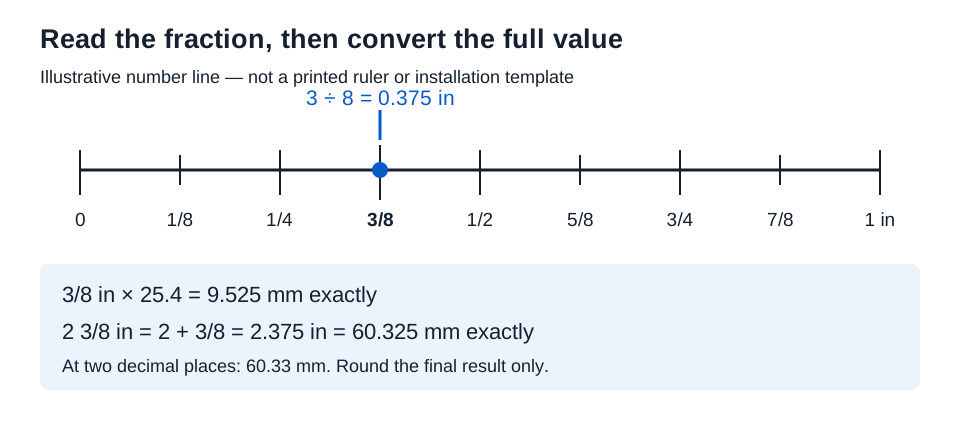
In a fraction such as 3/8 in, the denominator divides one inch into eight equal parts and the numerator counts three of them. Dividing 3 by 8 gives 0.375 in. Multiplying that complete value by the exact conversion factor, 25.4 mm per inch, gives 9.525 mm. The diagram marks the same position in fractional and decimal form.
Fraction, decimal, and millimeter table
Find the fraction in the first column, then read across without rounding an intermediate value. Every number in this table is exact for its stated fraction. Six decimal places are sufficient, and unnecessary trailing zeros are omitted. The 1/64 in interval is a lookup step, not instrument accuracy or an installation tolerance.
| Fraction (in) | Decimal (in), exact | Millimeters, exact |
|---|---|---|
| 0 | 0 | 0 |
| 1/64 | 0.015625 | 0.396875 |
| 1/32 | 0.03125 | 0.79375 |
| 3/64 | 0.046875 | 1.190625 |
| 1/16 | 0.0625 | 1.5875 |
| 5/64 | 0.078125 | 1.984375 |
| 3/32 | 0.09375 | 2.38125 |
| 7/64 | 0.109375 | 2.778125 |
| 1/8 | 0.125 | 3.175 |
| 9/64 | 0.140625 | 3.571875 |
| 5/32 | 0.15625 | 3.96875 |
| 11/64 | 0.171875 | 4.365625 |
| 3/16 | 0.1875 | 4.7625 |
| 13/64 | 0.203125 | 5.159375 |
| 7/32 | 0.21875 | 5.55625 |
| 15/64 | 0.234375 | 5.953125 |
| 1/4 | 0.25 | 6.35 |
| 17/64 | 0.265625 | 6.746875 |
| 9/32 | 0.28125 | 7.14375 |
| 19/64 | 0.296875 | 7.540625 |
| 5/16 | 0.3125 | 7.9375 |
| 21/64 | 0.328125 | 8.334375 |
| 11/32 | 0.34375 | 8.73125 |
| 23/64 | 0.359375 | 9.128125 |
| 3/8 | 0.375 | 9.525 |
| 25/64 | 0.390625 | 9.921875 |
| 13/32 | 0.40625 | 10.31875 |
| 27/64 | 0.421875 | 10.715625 |
| 7/16 | 0.4375 | 11.1125 |
| 29/64 | 0.453125 | 11.509375 |
| 15/32 | 0.46875 | 11.90625 |
| 31/64 | 0.484375 | 12.303125 |
| 1/2 | 0.5 | 12.7 |
| 33/64 | 0.515625 | 13.096875 |
| 17/32 | 0.53125 | 13.49375 |
| 35/64 | 0.546875 | 13.890625 |
| 9/16 | 0.5625 | 14.2875 |
| 37/64 | 0.578125 | 14.684375 |
| 19/32 | 0.59375 | 15.08125 |
| 39/64 | 0.609375 | 15.478125 |
| 5/8 | 0.625 | 15.875 |
| 41/64 | 0.640625 | 16.271875 |
| 21/32 | 0.65625 | 16.66875 |
| 43/64 | 0.671875 | 17.065625 |
| 11/16 | 0.6875 | 17.4625 |
| 45/64 | 0.703125 | 17.859375 |
| 23/32 | 0.71875 | 18.25625 |
| 47/64 | 0.734375 | 18.653125 |
| 3/4 | 0.75 | 19.05 |
| 49/64 | 0.765625 | 19.446875 |
| 25/32 | 0.78125 | 19.84375 |
| 51/64 | 0.796875 | 20.240625 |
| 13/16 | 0.8125 | 20.6375 |
| 53/64 | 0.828125 | 21.034375 |
| 27/32 | 0.84375 | 21.43125 |
| 55/64 | 0.859375 | 21.828125 |
| 7/8 | 0.875 | 22.225 |
| 57/64 | 0.890625 | 22.621875 |
| 29/32 | 0.90625 | 23.01875 |
| 59/64 | 0.921875 | 23.415625 |
| 15/16 | 0.9375 | 23.8125 |
| 61/64 | 0.953125 | 24.209375 |
| 31/32 | 0.96875 | 24.60625 |
| 63/64 | 0.984375 | 25.003125 |
| 1 | 1 | 25.4 |
Print the chart if a paper lookup is useful. It remains a numerical table at any print scale; do not measure the printed rows.
Use the converter for a full measurement
- Select inches for a fractional-inch input.
- Enter the number without a unit suffix:
7/64,0.109375, or a mixed number such as2 3/8. - Choose 0–6 decimal places, calculate, and distinguish the exact result from its rounded display.
- Retain the original dimension name and reference. A converted backset remains an edge-to-centerline distance, rather than a hole diameter.
The converter accepts zero and positive lengths. Inch inputs support fractions and mixed numbers; a mixed number needs a space and a proper fraction after the whole number. Decimal millimeter inputs do not accept fractions. Blank values, negative values, a zero denominator, unit suffixes, commas, and scientific notation are not supported. Inputs are limited to 64 characters and 12 decimal places; these are software bounds, not fit limits.
Worked example: a small fractional dimension
Inputs: 7/64, inches, three decimal places.
7 ÷ 64 = 0.109375 in
0.109375 × 25.4 = 2.778125 mm exactly
The displayed results are 0.109 in and 2.778 mm. Both are rounded views of the exact length. If you instead convert the rounded 0.109 in, you get 2.7686 mm, because you have changed the input. Use the original fraction or exact decimal for subsequent calculations.
Worked example: a mixed number
Inputs: 2 3/8, inches, two decimal places.
2 + 3/8 = 19/8 = 2.375 in
2.375 × 25.4 = 60.325 mm exactly
The displayed values are 2.38 in and 60.33 mm. The converter uses half-up rounding: an exact halfway case rounds away from zero. A three-decimal display would show 2.375 in and 60.325 mm, with no loss for this example.
Choose a value without inventing a tolerance
A measured 0.380 in falls between this chart’s 3/8 in (0.375 in) and 25/64 in (0.390625 in) rows. Its conversion is 0.380 × 25.4 = 9.652 mm; it does not need to be forced onto either fraction. Whether rounding to a nearby fraction is acceptable depends on the task and the applicable drawing.
Use dimensional comparison when you have a target and, optionally, documented lower and upper limits. A rounded display must never replace those limits. Exact unit conversion also does not remove uncertainty from the original measurement.
Conclusion
Read the original fraction, convert the entire value, and round only the final display. Keep the measurement reference and source with the number. This preserves the physical dimension while changing how it is written.
Source and calculation basis
NIST, SI Units—Length gives 1 in = exactly 25.4 mm. Each chart row is derived from n/64 × 25.4, for integer n from 0 through 64, with the fraction reduced for display. These relationships provide unit conversions, not manufacturer specifications or installation allowances.