A total length and a cut list answer different questions. A takeoff budgets the lengths required for a task. A cutting plan assigns individual pieces to actual stock, including the kerf convention used by the planner. Preserve each dimension’s meaning from the survey through the finished piece; a purchasing percentage cannot repair an incomplete piece list.
Define each finished piece and its endpoints
Record the part, source drawing, endpoint convention, quantity, and any justified extra on the takeoff and cut-review sheet. Confirm that the product may be cut and that its profile, fixing, and joint details are understood. Separate straight pieces from mitered members and curved parts.
| Task | Tool | Important distinction |
|---|---|---|
| Add runs and explicit purchasing allowances | Continuous hardware length | A budget is not a stock allocation |
| Allocate straight finished pieces to identical stock | Stock cutting planner | One kerf is charged per piece, including the last |
| Derive a planar rectangular surround’s miter lengths | Rectangular frame miter | Short points and long points are different dimensions |
| Describe a circular curve | Arched segment geometry | Arc length is not automatically a straight-stock cutting length |
Build a takeoff before applying its purchasing percentage
For a hypothetical linear-hardware takeoff, select inches and enter 80,2 and 36,1, one length/quantity pair per line. Enter 0.5 in total extra per piece and 10% additional purchasing allowance. These assumptions illustrate the calculation and are not installation allowances.
Net length = 2 × 80 + 1 × 36 = 196 in
Piece count = 2 + 1 = 3
Total with per-piece extras = 196 + 3 × 0.5 = 197.500 in
Purchasing budget = 197.5 × (1 + 10/100) = 217.250 in
The budget converts exactly to 5518.150 mm. The piece list contains two 80.500 in pieces and one 36.500 in piece. The percentage increases the overall budget after the per-piece extras; it does not lengthen each finished cut.
The extra is the total for each piece, not an amount automatically applied to each end. Use separate takeoffs when different pieces need different extras. The tool supports 1–50 rows, positive net lengths, whole quantities 1–1,000, and a 0–100% purchasing allowance. Enter zero explicitly when no allowance applies.
Allocate pieces and reconcile every stock length
For a separate cutting example, enter two 60 in pieces and two 35 in pieces as 60,2 and 35,2. Supply 100 in usable stock and 1/8 in kerf. Usable stock means the length remaining after any independently allowed end trims.
The planner sorts pieces from longest to shortest, then places each in the first stock row that can hold it. This is first fit decreasing, a reproducible heuristic that does not guarantee the fewest stock lengths.
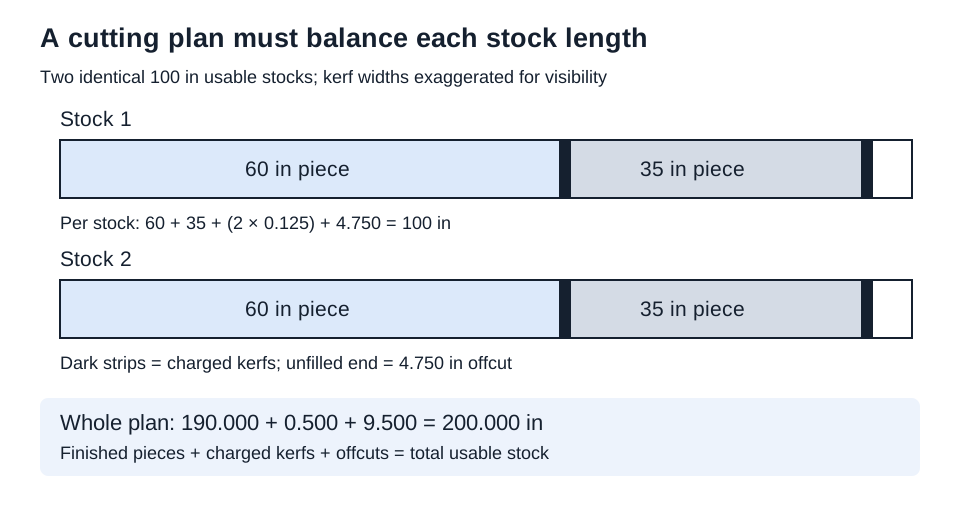
| Stock | Finished pieces (in) | Charged kerfs (in) | Used (in) | Offcut (in) |
|---|---|---|---|---|
| 1 | 60 + 35 | 2 × 0.125 = 0.250 | 95.250 | 4.750 |
| 2 | 60 + 35 | 2 × 0.125 = 0.250 | 95.250 | 4.750 |
| Total | 190.000 | 0.500 | 190.500 | 9.500 |
Check the balance: 190 + 0.5 + 9.5 = 200 in of usable stock. Finished pieces occupy 190/200 × 100 = 95%; kerfs are not useful finished length.
A piece plus its charged kerf must fit in one stock. The planner supports up to 50 rows and 100 finished pieces. It charges the last piece’s kerf as well, so two pieces totaling the stock length do not fit when kerf is positive. Real cutting sequences may use a different convention; reconcile the model before treating the table as a work instruction.
Keep miter points and curved geometry explicit
For a hypothetical 36 × 80 in inside opening and 2 in face-width members, the miter tool gives:
Horizontal long point = 36 + 2 × 2 = 40 in
Vertical long point = 80 + 2 × 2 = 84 in
There are two horizontals, each 36 in short / 40 in long, and two verticals, each 80 in short / 84 in long. Each end is 45° from a square crosscut. These are planar equal-width members meeting at 90° corners; rebates, compound profiles, kerf, and allowances are excluded.
For an ideal circular arch, a 36 in chord and 18 in rise give:
Radius R = 36²/(8 × 18) + 18/2 = 18 in
The arc is a semicircle, so inner length is 18π ≈ 56.549 in. With 2 in outward radial depth, outer radius is 20 in and outer length 20π ≈ 62.832 in. Ordered points (0,0), (18,18), (36,0) in describe the same top semicircle, clockwise from the first point. Other through-points can select different arcs. Three measurements do not prove that the entire real outline is circular.
Arc length does not decide whether a part is bent, segmented, laminated, or cut from sheet stock. Establish that fabrication method before assigning material.
Review the list before purchasing or cutting
Keep original lengths through the calculation and round only for final display. Exact arithmetic results use three-decimal half-up rounding; circular lengths are three-decimal approximations. Conversion uses 1 in = 25.4 mm.
Retain the piece list, dimensional conventions, extras, usable stock, kerf, and assigned cuts. Check actual stock availability, defects, profile orientation, saw limits, and product instructions separately. The completed calculation supports a stated budget or allocation; it does not establish an optimal plan or permission to cut a particular assembly.