A larger outline does not necessarily cover an existing opening. Center offset can leave part of the opening exposed even when the proposed diameter, width, or height is greater. First identify the actual shapes and their centers. Then choose either circular containment or rectangular coverage.
These tools answer geometric questions in one plane. They do not determine whether a door can be modified or whether a plate, lock, fastener pattern, or reinforcement is suitable.
Choose the shape and define the offset
Use offset bore geometry for two complete circles. Measure both diameters and the straight-line center distance. Its directional question is whether the proposed circle contains the entire existing circle. A statement that “one circle is inside the other” is insufficient if the proposed circle is the smaller one.
Use cover plate coverage for a rectangular opening and rectangular plate with parallel edges. Locate the plate center relative to the opening center: positive x moves the plate right; positive y moves it up. Rotation, rounded corners, and irregular damage require additional geometry.
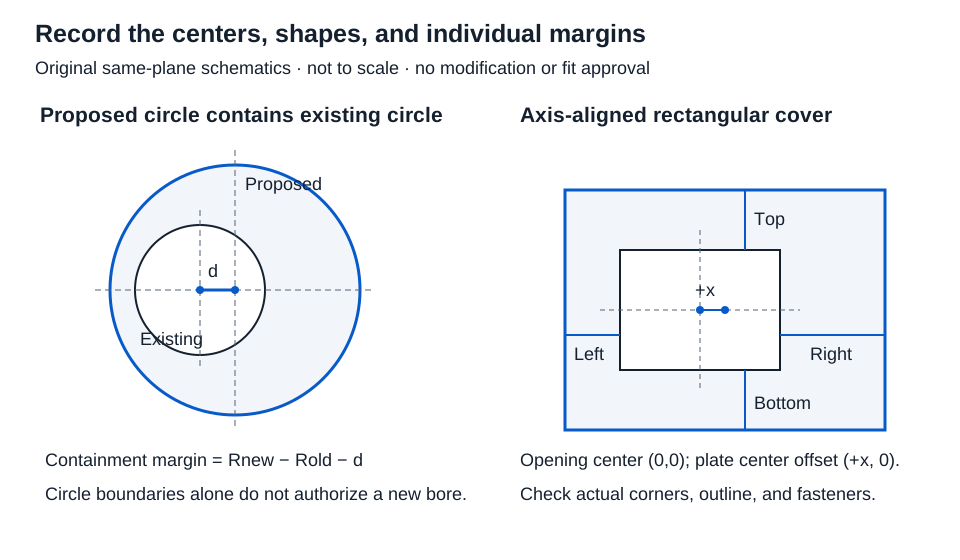
Use the opening and cover record to retain the outlines, center references, units, and source drawing. For bored-lock measurements, keep backset and bore diameter separate.
Test circular containment from the farthest boundary
Take hypothetical inputs of 1 in existing diameter, 2 in proposed diameter, and 1/4 in center distance.
- Select inches in offset bore geometry.
- Enter the complete diameters as
1and2; do not enter radii. - Enter
1/4as the center distance. - Calculate, then read the directional containment result and the signed margin together.
The existing radius is 0.5 in and proposed radius 1 in. The farthest old boundary lies 0.25 + 0.5 = 0.75 in from the proposed center. Therefore:
Containment margin = proposed radius − center distance − existing radius
1 − 0.25 − 0.5 = 0.250 in = 6.350 mm
The proposed circle contains the old circle under these inputs. A positive margin is the smallest radial surplus; it is not overlap area or remaining wall thickness.
| Center distance (in) | Unrounded margin (in) | Directional result |
|---|---|---|
| 0.25 | +0.25 | Contained with positive margin |
| 0.5 | 0 | Contained, with internal boundary contact |
| 0.5001 | −0.0001 | Not contained, despite a display near zero |
The diameters must be positive; center distance may explicitly be zero. Containment includes boundary contact and uses the original dimensions before three-decimal display rounding. A tiny negative result must not be accepted because the displayed margin looks like zero.
Check every rectangular edge against the required margin
For a separate hypothetical case, use a 2 × 3 in opening, a 4 × 5 in plate, x = +1/4 in, y = 0, and a supplied minimum margin 1/2 in.
In cover plate coverage, select inches, enter both width/height pairs, and enter the two signed center offsets. Supply the required minimum explicitly. Zero means coverage alone; a positive value is your stated edge-margin requirement.
For opening width w and height h, plate width W and height H:
Left = (W − w)/2 − x; right = (W − w)/2 + x
Bottom = (H − h)/2 − y; top = (H − h)/2 + y
| Edge | Calculation (in) | Margin (in) | Margin (mm), exact |
|---|---|---|---|
| Left | (4 − 2)/2 − 0.25 | 0.750 | 19.050 |
| Right | (4 − 2)/2 + 0.25 | 1.250 | 31.750 |
| Bottom | (5 − 3)/2 − 0 | 1.000 | 25.400 |
| Top | (5 − 3)/2 + 0 | 1.000 | 25.400 |
The smallest margin is 0.750 in, so all four meet the entered 0.500 in requirement. Moving right reduces the left margin because the left plate edge moves toward the opening. At x = 0.5 in, that margin equals 0.5 in and still meets it. At x = 0.5001 in, it is 0.4999 in and fails, even though a three-decimal display reads 0.500 in.
Opening and plate dimensions must be positive. Offsets may be signed, while the required margin must be nonnegative. A negative resulting margin identifies an exposed edge. If the plate is narrower than the opening, a lateral move cannot produce nonnegative margins on both opposing sides.
Preserve the geometric result without expanding its meaning
The circle and rectangle formulas follow directly from their radii and edge coordinates. Exact length conversion uses 1 in = 25.4 mm; displayed margins use three-decimal half-up rounding, without rounding the decision inputs.
Before using a result, compare the real outlines and mounting details with the model. Rounded plate corners can expose an opening that a rectangular envelope appears to cover. Fastener edge distance, support area, lock-body fit, reinforcement, ratings, and permitted modifications remain separate checks. Retain the calculation as evidence for the specific containment or coverage question, then use the applicable product instructions for the installation decision.