A measured run, a finished piece, and a stock length are not interchangeable. A takeoff estimates the total material budget. A cut list specifies individual finished pieces. A stock allocation checks which pieces fit in each usable length after the stated kerf. This reference keeps those records separate and shows how to reconcile them before a cutting review.
Start with net runs and explicit extras
Use the continuous hardware length takeoff for positive net lengths and whole-number quantities. Select a common unit, then enter one length, quantity pair per line. Supply the total end or joint extra per piece and a separate additional purchasing percentage. If a drawing gives extras at both ends, add them before entering the per-piece value.
The tool accepts 1–50 rows, 1–1,000 pieces per row, and a 0–100% additional percentage. These are software bounds. Zero is allowed for extras and percentage, but not for net piece length. An allowance must come from the task; it is not an embedded recommendation.
Worked example: a material budget
Inputs: inches selected; rows 80, 2 and 36, 1; per-piece extra 0.25 in; additional purchasing allowance 10%.
| Item | Quantity | Net each (in) | Extra each (in) | Finished each (in) | Finished total (in) |
|---|---|---|---|---|---|
| Long run | 2 | 80.000 | 0.250 | 80.250 | 160.500 |
| Short run | 1 | 36.000 | 0.250 | 36.250 | 36.250 |
Net total = 2 × 80 + 36 = 196 in
Finished total = 196 + 3 × 0.25 = 196.750 in
Purchasing budget = 196.75 × 1.10 = 216.425 in
The finished pieces remain 80.250, 80.250, and 36.250 in. The 10% purchasing allowance does not increase every finished cut length. It also does not prove that those pieces fit in the stock offered by a supplier.
Reconcile a stock allocation piece by piece
Use the stock cutting planner with finished piece lengths, identical usable stock length, and kerf per piece. Subtract any fixed end trims from the stock length before entering its usable value. Do not include the same trim again in a piece or allowance.
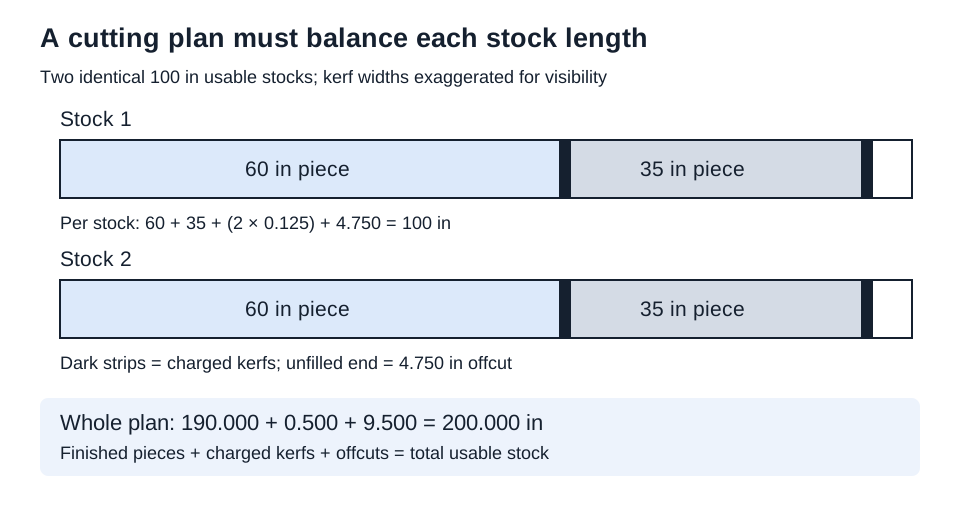
Example inputs: rows 60, 2 and 35, 2; usable stock 100 in; kerf 0.125 in. The planner charges one full kerf for every piece, including the last piece in each stock.
Used per stock = 60 + 35 + 2 × 0.125 = 95.250 in
Offcut per stock = 100 − 95.25 = 4.750 in
For two stocks, the independent balance is:
190.000 in finished pieces + 0.500 in kerfs + 9.500 in offcuts = 200.000 in usable stock
This first-fit-decreasing planner sorts long pieces first and places each in the first stock with sufficient remaining capacity. It does not guarantee the minimum stock count. The planner supports at most 100 pieces in total; each piece plus its charged kerf must fit one usable stock. Check the actual cut sequence, stock defects, profile direction, saw constraints, and whether the model’s kerf accounting matches the process.
Preserve short-point and long-point dimensions
The rectangular frame miter calculator models four equal-face-width members meeting at 45° miters. Enter the inside opening width and height, not the outside frame dimensions.
Example inputs: inside opening 36 × 80 in, member face width 2 in.
Horizontal long point = 36 + 2 × 2 = 40 in
Vertical long point = 80 + 2 × 2 = 84 in
| Member | Quantity | Short point (in) | Long point (in) | Each end cut from square |
|---|---|---|---|---|
| Horizontal | 2 | 36.000 | 40.000 | 45° |
| Vertical | 2 | 80.000 | 84.000 | 45° |
These are geometric points on the member. Actual fabrication may need process-specific allowances. State which point defines a finished length before using that value in the stock planner.
Keep curved lengths separate from straight stock
For a circular segment, the arch calculator accepts a positive chord and rise, with rise no greater than half the chord in that mode. Its inner radius is:
R = chord²/(8 × rise) + rise/2
Example inputs: chord 36 in, rise 18 in, radial depth 0 in.
R = 36²/(8 × 18) + 18/2 = 18 in
This is a semicircle, so its angle is π radians and inner arc is 18π ≈ 56.5486678 in, displayed as 56.549 in. The arc is not the 36 in chord and is not automatically a straight-stock cutting length.
In three-point mode, preserve the point order P1 → P2 → P3, common plane, origin, axes, and unit. That order selects the arc through the middle point and can select a major arc. Three noncollinear points define a circle; they do not prove that an entire measured profile follows it.
Conclusion
Keep the net takeoff, finished dimensions, and stock allocation traceable to one another. Check each stock’s material balance and every piece’s dimension convention before cutting. The arithmetic uses unrounded values with final three-decimal displays and exact unit conversion. No purchasing percentage, kerf assumption, or calculated shape authorizes shortening hardware or altering a door assembly.