A door’s mass is useful evidence for a hinge assessment, but it does not select a hinge. Mass distribution, support behavior, mounting geometry, reinforcement, fasteners, and manufacturer application limits can remain unresolved after the mass is known. Collect those inputs separately so one result is not mistaken for another.
Identify what the mass figure includes
Prefer applicable manufacturer data or a suitable measurement of the actual assembly. Identify whether the figure includes glazing, hardware, finishes, and attachments. Do not enter the complete assembly and then add components already included in that mass.
The door weight calculator offers two bases: volume and density for a uniform rectangular solid, or area and a supplied weight per unit area for a rectangular panel. Outside dimensions multiplied by solid-metal density do not describe an entire hollow metal door.
For a hypothetical 36 × 80 × 1.75 in uniform solid and supplied density 35 lb/ft³:
- Select inches for the dimensions and lb/ft³ for density.
- Enter width
36, height80, thickness1.75, and density35. - Calculate, then retain the density assumption alongside the estimate.
Volume = 36 × 80 × 1.75 = 5040 in³
Volume in ft³ = 5040/1728 = 35/12 ft³
Estimated mass = (35/12) × 35 = 1225/12 = 102.083333… lb
Using exactly 0.45359237 kg per lb, the mass is 46.304221… kg. The tool displays 102.1 lb / 46.3 kg at one decimal place. All dimensions and density must be positive. The density is an illustrative assumption, not a verified material or door property.
When the source gives weight per unit area
Use the area-based mode when the applicable product data gives lb/ft² or kg/m². Enter the panel’s width and height, that value and its unit, and a source record explaining what the mass includes. Do not enter lb/ft² in a lb/ft³ density field or infer glass density from a layered product’s overall thickness.
For a separate hypothetical 36 × 80 in panel and 5 lb/ft², area is 36 × 80/144 = 20 ft²; mass is 20 × 5 = 100 lb = 45.359237 kg, displayed 100.0 lb / 45.4 kg. The value 5 is an arithmetic assumption, not a glass product specification. The result excludes anything outside the supplied mass-per-area figure, such as separate frame or lock hardware. Obtain those masses before treating the record as a complete assembly.
Separate total mass, center of mass, inertia, and force
| Quantity | Tool or evidence | What it does not establish |
|---|---|---|
| Mass, lb or kg | Actual assembly data or a qualified solid-density estimate | Hinge force, distribution, or capacity |
| Center of mass, in or mm | Component center-of-mass calculator | Distributed rotational inertia |
| Inertia, kg·m² | Uniform-leaf rotational inertia | A hinge rating or stopping force |
| Support reactions, lbf or N | Specified two-support model | Load sharing among actual hinges |
| Minimum open hinge width, in or mm | Conditional hinge-width geometry | An available stock size or load capacity |
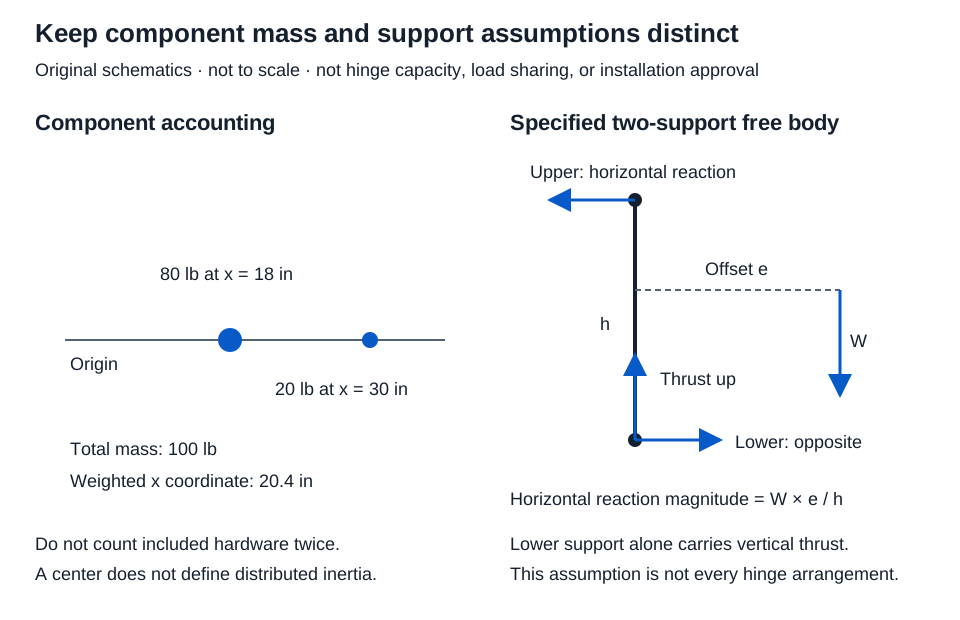
For the center-of-mass example, select pounds and inches, then enter 80,18,0,0 and 20,30,0,0, one mass/x/y/z row per line. The x-coordinate is:
xCOM = Σ(mx)/Σm = (80 × 18 + 20 × 30)/(80 + 20) = 20.400 in
The y and z coordinates are zero for these inputs. The weighted-coordinate relationship locates the combined center. All component centers must share one coordinate system; positive masses and 1–50 rows are required.
Use the actual mass distribution for an inertia question
The inertia tool assumes one uniformly distributed rectangular leaf rotating about a specified parallel vertical axis. It uses the parallel-axis relationship:
Iaxis = m(w² + t²)/12 + m[(w/2 − px)² + (t/2 − py)²]
As a separate, explicitly metric example, select millimeters and kilograms. Enter 1000 mm width, 100 mm thickness, 12 kg, pivot (0,50) mm, and 2 rad/s angular speed. After conversion to meters:
Icenter = 12(1² + 0.1²)/12 = 1.01 kg·m²
Axis shift = 12[(0.5 − 0)² + (0.05 − 0.05)²] = 3 kg·m²
Iaxis = 4.010 kg·m²; energy = Iω²/2 = 4.01 × 2²/2 = 8.020 J
This example does not describe the component arrangement above. A total mass and center alone cannot establish a nonuniform assembly’s distributed inertia.
Check support assumptions before using a reaction
In ideal support reactions, enter a separately specified 100 lbf force, 18 in horizontal offset, and 60 in vertical support separation.
Each horizontal reaction = W × offset/separation = 100 × 18/60 = 30.000 lbf
The equal, opposite horizontal reactions balance the gravity moment. The lower support carries 100 lbf vertical thrust; the upper carries zero vertical thrust in this model. It follows static equilibrium, not an assumption that every hinge assembly behaves this way.
Force and separation must be positive; offset may explicitly be zero. Real supports may share thrust, transmit moments, deflect, or engage differently. The tool does not divide weight equally among hinges. Do not silently copy a mass in lb or kg into its force field.
Evaluate open hinge width as a separate geometry
The hinge-width tool implements Hager’s stated relationship. First match the actual closed-position geometry and identify the back face, hinge backset, and required clearance. Hinge backset is different from lock backset.
With hypothetical thickness 1.75 in, hinge backset 0.25 in, and required clearance 1 in:
Minimum open width = 2(thickness − hinge backset) + clearance
2(1.75 − 0.25) + 1 = 4.000 in = 101.600 mm
The backset must be less than thickness; backset and added clearance may be zero. This geometric minimum is not a stock-size or capacity recommendation. Do not extend the formula to a concealed hinge, pivot, or other mechanism whose geometry differs.
Complete the product assessment with the right evidence
Retain original values and source revisions in the mass, force, and hinge record. Length conversion uses exactly 25.4 mm per inch. Most outputs above display three decimals; mass estimates use one decimal. Rounded displays do not define tolerances.
Use the completed record to check the exact hinge and its application conditions, door/frame reinforcement, fasteners, permitted dimensions, and installation instructions. Calculations can support those checks, but they cannot supply missing product ratings or approve the full assembly.